Will Your Vibe-Coded MVP Survive Investor Due Diligence?
ISHIR helps founders uncover technical debt, fix critical security gaps, and prepare investor-ready engineering reports before fundraising.

You built an MVP in three weeks. Customers are signing up. Your demo works. Investors are interested.
Then someone asks for access to your GitHub repository.
Suddenly, the conversation changes.
Who wrote the code? Which parts were generated by AI? Has a senior engineer reviewed the architecture? Can you explain how authentication works? What happens if the application needs to support 100,000 users instead of 100?
And perhaps the most uncomfortable question: What would it cost to rebuild the parts that are not production-ready?
If you built your application using Lovable, Cursor, Bolt, or another AI coding platform, these are questions worth answering before an investor asks them.
The problem is not that you used AI to build your product. The problem begins when nobody can explain, secure, test, or maintain what AI built.
That distinction can influence how investors assess your technology, how much additional engineering they expect, and what conditions they attach to a deal.
AI-generated code is not automatically a red flag in technical due diligence. Code that nobody can explain, test, secure, or maintain is. Investors assess whether the software is technically defensible, commercially scalable, and expensive to repair. Undocumented AI-generated code can introduce security vulnerabilities, ownership uncertainty, and technical debt that affects investment decisions and acquisition negotiations.
This matters because building software and owning a dependable software business are two different achievements.
A functioning prototype demonstrates that an idea can work. A technically sound product demonstrates that the business can continue operating when the original builder leaves, customer demand increases, or security requirements become more demanding.
That gap is where vibe coding technical debt becomes a financial issue.
AI-generated code can be syntactically correct, functionally convincing, and insecure at the same time.
Veracode’s 2026 GenAI Code Security Report found that approximately 44% of the evaluated AI code-generation tasks produced code containing a detectable vulnerability associated with the OWASP Top 10. The study measured generated outputs under specific test conditions, not the vulnerability rate of every AI-built application in production.
Still, the implication for founders is important.
A working application is not evidence that the underlying code has been security-reviewed.
A separate 2026 study published in Empirical Software Engineering examined 2,315 code snippets from real developer interactions and identified 56 confirmed vulnerabilities across 48 files. Even advanced AI models did not identify and repair every issue during subsequent testing.
The lesson is not that AI-generated software is inherently worse than human-written software. Human developers introduce vulnerabilities too.
The lesson is that code provenance, independent review, and verifiable testing matter regardless of who or what created the software.
For founders, this means treating AI-generated code as software that requires engineering accountability, not as an exception to ordinary security practices.
There is no universal investor checklist requiring founders to disclose a particular percentage of AI-generated code. Requirements depend on the investor, transaction, product, industry, and the technical risks involved.
However, a serious technical due diligence review may investigate several areas.
A reviewer might ask whether Lovable generated the frontend, Cursor assisted with backend functionality, or another AI system produced critical business logic.
The precise percentage is not always the most useful measure. Understanding which components were generated, modified, reviewed, and tested is more important.
An AI-generated landing page carries a different risk profile from an AI-generated payment authorization service.
Can someone explain how data moves through the application? Why particular frameworks were selected? How services communicate? What happens when a critical dependency fails?
If every architectural question ends with “the AI generated it,” the reviewer has discovered a knowledge gap.
That gap can translate into additional engineering work, slower product development, and dependence on outside specialists.
A successful deployment does not prove that the software is reliable.
Reviewers may ask for automated test results, security assessments, error logs, dependency scans, infrastructure documentation, and evidence of how defects are resolved.
They want to know whether the application behaves predictably outside the happy path demonstrated to investors.
This becomes particularly important for SaaS, fintech, healthcare, enterprise AI, and applications handling personally identifiable information.
A reviewer may test whether one customer can access another customer’s records, whether administrative functions are restricted, or whether credentials have leaked into browser-accessible code.
These are practical security concerns with potentially serious commercial consequences.
Investors are not only evaluating what has already been built. They are evaluating what it will take to build the next version.
If onboarding a new developer requires deciphering thousands of lines of unexplained code, the product may be more expensive to scale than the pitch deck suggests.
Investors may be comfortable with AI-assisted development. They are less likely to be comfortable with engineering risk nobody has quantified.
Some technical weaknesses are inconvenient. Others can expose customer data, interrupt operations, or threaten a transaction.
The following are common risk categories worth investigating in AI-assisted MVPs. They are not claims about the prevalence of defects in any specific coding platform.
Imagine your MVP connects to a payment processor, database, and third-party AI service.
During development, an API key is placed directly into a frontend configuration file to make the integration work. The application functions, so nobody revisits the implementation.
Unfortunately, code delivered to a user’s browser is not a safe place for confidential credentials.
A technical reviewer may inspect bundled JavaScript, repository history, environment configuration, and access policies to identify exposed credentials.
Why it matters: Exposed secrets can allow unauthorized API usage, unexpected charges, access to sensitive resources, or other security incidents.
What to fix: Move confidential operations to trusted server-side components, use managed secret storage, restrict privileges, rotate exposed credentials, and examine repository history. Removing a key from the latest commit does not invalidate copies already exposed.
A login screen is not proof of secure authorization.
Consider a SaaS dashboard where an authenticated user can retrieve another customer’s records by changing an identifier in an API request.
The application correctly recognizes the user but fails to verify whether that user has permission to access the requested information.
This is a broken object-level authorization problem, sometimes referred to as BOLA or IDOR.
Why it matters: Cross-customer data exposure can create security, contractual, regulatory, and reputational risks.
What to fix: Enforce authorization on the server for every protected operation, validate access at the resource level, and test users with different roles and tenant memberships.
For multi-tenant SaaS products, this should be a priority before a fundraising data-room review.
Your MVP works when the founder clicks through it.
But what happens when a subscription renews twice, a payment fails, an external API times out, or two users modify the same record simultaneously?
AI coding tools can generate tests, but tests must still be selected, reviewed, executed, and maintained. They should validate business behavior rather than merely confirm that code runs.
A repository with little test coverage may indicate that important changes cannot be made safely.
Why it matters: Investors may anticipate higher regression risk, slower releases, more manual QA, and additional costs to stabilize the application.
What to fix: Prioritize integration and automated tests around authentication, authorization, payments, customer data, and revenue-generating workflows. Add meaningful unit tests where they reduce risk.
The number of tests matters less than the critical behaviors they actually verify.
You asked your AI coding tool to add a feature. It created a new function instead of reusing an existing one.
You asked for a second dashboard. It generated another set of database queries.
You changed the subscription logic, but the old version still exists in a different module.
Individually, these changes may seem harmless. Over time, they can produce inconsistent business rules, difficult debugging, and increasingly expensive feature development.
Why it matters: Maintenance complexity can increase engineering costs and reduce the speed at which a startup can deliver its roadmap.
What to fix: Identify duplicated business logic, establish clear module boundaries, consolidate shared services, document architectural decisions, and refactor high-change areas.
The objective is not to make every file elegant. It is to ensure that future development does not become progressively more expensive.
AI-generated applications can incorporate third-party packages, templates, libraries, and generated components.
A package may be outdated, unnecessary, vulnerable, or subject to a license that requires additional review.
Not every dependency problem is a legal or security crisis. But a founder who cannot identify the application’s dependencies, licenses, and ownership boundaries creates uncertainty during diligence.
Why it matters: Vulnerable dependencies may need replacement, while licensing or intellectual property questions may require legal review or additional documentation.
What to fix: Inventory direct and transitive dependencies, generate a software bill of materials where appropriate, scan for known vulnerabilities, review applicable licenses, and establish a documented approval process.
This is particularly important when a startup is entering enterprise procurement or acquisition discussions.
Here is the question founders really want answered:
Will investors reduce my valuation because I used AI to build my MVP?
Not simply because you used AI.
Investors generally evaluate the risk and economics of the business, including the cost of maintaining, securing, and scaling its technology.
Weaknesses discovered during technical due diligence may influence the transaction through additional remediation costs, delayed closing, revised deal conditions, retention of funds, or reduced confidence in the business.
Not every finding changes the price. Some are inexpensive to resolve. Others affect the assumptions supporting the investment.
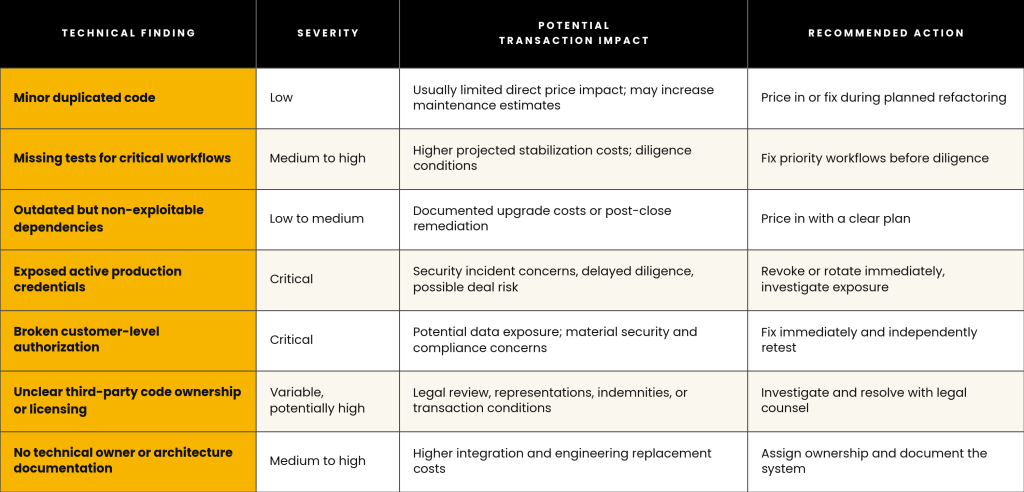
Severity and transaction impacts are illustrative. Actual implications depend on exploitability, customer exposure, contractual obligations, deal structure, investor risk tolerance, and the cost of remediation.
Consider a hypothetical startup discussing a $5 million valuation.
During diligence, an independent engineering assessment identifies $120,000 of necessary stabilization and security work.
The investor might ask the founder to complete the work before closing, negotiate a different valuation, reserve funds for remediation, or proceed with a contractual condition.
But the existence of $120,000 in technical debt does not automatically mean the valuation falls by $120,000.
The financial impact depends on whether that work was already anticipated, how urgently it must be completed, whether it creates business interruption risk, and how the deal is structured.
A useful way to evaluate technical debt is to consider four elements:
Remediation cost + operational exposure + future maintenance burden + execution uncertainty.
These are not interchangeable or mechanically additive. They represent the different ways an engineering issue can influence commercial judgment.
A minor refactoring task might not materially affect negotiations. A vulnerability allowing unrestricted customer data access could have consequences far beyond the cost of fixing the code.
That is why founders should quantify and prioritize technical debt before entering a transaction.
The objective of pre-investment code cleanup is not to rebuild the entire application. It is to eliminate unacceptable risks and create a credible plan for everything else.
Active exposed credentials, broken authorization, exploitable security vulnerabilities, and defects affecting payment or customer data integrity belong in this category.
These problems should be treated as urgent because continued operation may expose the company or its customers to immediate harm.
For live security issues, containment and incident assessment take precedence over the fundraising timeline.
Duplicated logic, maintainability issues, documentation gaps, and certain dependency upgrades may be manageable if they are well understood.
They should have an identified owner, realistic cost estimate, business impact assessment, and target remediation date.
The important distinction is between acknowledged technical debt and unknown technical debt.
An investor may accept a documented improvement plan more readily than an assurance that no problems exist.
Unresolved intellectual property questions, serious security incidents, unverified customer data isolation, or a system that cannot be operated without a particular individual can create substantial diligence concerns.
These may require specialist review, legal involvement, significant remediation, or changes to the transaction structure.
The right response is evidence, not reassurance.
A focused 10-day cleanup sprint can identify critical risks, resolve a defined set of high-priority findings, and prepare documentation for a technical due diligence review.
It is not a guarantee that every application can be made production-ready in 10 days. The scope depends on application complexity, access to the codebase, test environments, and the severity of discovered issues.
For a relatively small MVP with a functioning build, an organized engineering team can use the following approach.
Identify all source repositories, production environments, deployment platforms, databases, integrations, and privileged accounts.
Document the application’s basic architecture and confirm who controls the source code, infrastructure, domains, and critical vendor relationships.
The outcome should be a clear understanding of what the company owns and operates.
Record which development tools were used and which parts of the application were substantially generated or modified with AI assistance.
Identify business-critical components, their current maintainers, and whether they have undergone human review.
Where reliable code-generation metrics are unavailable, classify involvement as AI-generated, AI-assisted, human-authored, or unknown rather than inventing percentages.
Scan the repository and relevant history for credentials, tokens, private keys, and unsafe configurations.
Identify vulnerable dependencies, unsupported packages, and licensing concerns.
Immediately revoke or rotate confirmed exposed credentials. Do not postpone active security risks until the end of the sprint.
Review login mechanisms, session handling, access control, API permissions, and administrative functions.
Test whether users can access records or operations belonging to other accounts or tenants.
Use established application security verification requirements as a baseline and validate findings through authorized testing.
Map key services, database relationships, critical workflows, and external dependencies.
Look for duplicated business rules, fragile integrations, missing database constraints, unhandled failures, and areas where architectural assumptions are unclear.
Prioritize issues that could cause data corruption, customer disruption, or expensive rework.
Create or repair tests for the workflows that matter most to customers and revenue.
Focus on registration, authentication, authorization, billing, data access, and core product functionality.
Capture baseline results and distinguish newly added tests from those that were already passing.
Implement targeted fixes for issues identified during the first six days.
Avoid broad rewrites unless a specific component presents unacceptable risk and incremental remediation is impractical.
Use peer review, controlled changes, and repeatable testing to verify the fixes.
Confirm that another engineer can build, deploy, and troubleshoot the application.
Review environment separation, backup procedures, restore capability, logging, monitoring, and incident-response ownership.
A product that works only in its original developer’s environment is not ready for a serious operational assessment.
Have a senior engineer who did not implement the changes review the critical findings, code modifications, test evidence, and unresolved risks.
Retest remediated vulnerabilities and confirm whether they are genuinely closed.
Record any remaining limitations instead of labeling untested components as secure.
Consolidate the architecture summary, code provenance inventory, security findings, remediation evidence, test results, dependency inventory, and outstanding technical debt.
Separate completed fixes from planned work.
The final report should explain what was evaluated, how it was evaluated, what remains uncertain, and which risks the founder has accepted or plans to resolve.
The objective is not to claim that the software is perfect. It is to demonstrate that the business understands and controls its engineering risks.
At ISHIR, we help founders move from a working AI-built prototype to a codebase that can withstand structured technical review.
Our approach begins with a pre-diligence assessment. Senior engineers examine the application’s architecture, critical source code, authentication and authorization, dependencies, security controls, testing practices, and deployment readiness. Instead of immediately recommending a rewrite, we identify the issues that present real business risk and distinguish them from maintainability improvements that can be scheduled later.
Through ISHIR’s Vibe Coding Cleanup Services, founders can get experienced engineering oversight without discarding the speed advantage that helped them launch.
The outcome is a stronger technical foundation and clearer evidence for conversations with investors, acquirers, enterprise customers, and incoming engineering leaders.
ISHIR helps founders uncover technical debt, fix critical security gaps, and prepare investor-ready engineering reports before fundraising.
Not automatically. Investors and technical reviewers are generally more concerned with security, maintainability, software ownership, and operational risk than the identity of the code author. AI-generated code becomes a concern when it lacks adequate testing, review, documentation, or security controls.
Some investors or technical reviewers may ask about the extent and purpose of AI-assisted development, but there is no universal percentage threshold. They may examine critical components, code history, ownership, and review processes. A component-level provenance record is often more useful than an unsupported estimate of total AI-generated code.
A focused 10-working-day sprint may be enough to audit a small MVP, fix selected critical problems, introduce essential tests, and create a technical diligence report. Larger systems, significant security weaknesses, or architectural problems may require several additional weeks or more. The timeline should be based on an initial assessment.
Yes, potentially. Technical weaknesses can increase projected remediation costs, create security and continuity risks, or reduce investor confidence. They may influence valuation discussions, transaction conditions, or closing timelines. However, there is no standard discount applied simply because a startup used AI coding tools.
Not without first assessing the existing system. Many AI-assisted applications can be improved through targeted security fixes, testing, documentation, and architectural refactoring. A complete rewrite may be justified when structural problems make safe maintenance impractical, but it should not be the default recommendation.
There is no single highest risk for every application. Exposed credentials, broken authorization, weak tenant isolation, insecure data access, and vulnerable dependencies are important areas to assess. The most serious issue depends on what an attacker could exploit and which data or business operations could be affected.
A useful documentation package includes an architecture diagram, repository and infrastructure inventory, AI Code Provenance Log, dependency inventory, license review, security assessment, automated test evidence, deployment documentation, and a prioritized remediation register. The package should distinguish verified results from assumptions or planned improvements.
Yes. A founder does not need to personally understand every line of code, but the company needs accountable technical ownership and credible evidence of software quality. Independent senior engineers can assess the system, document its risks, remediate critical issues, and help prepare a defensible technical diligence report.
The post Your Vibe-Coded MVP Works. But Will It Survive Investor Due Diligence? appeared first on ISHIR | Custom AI Software Development Dallas Fort-Worth Texas.


